
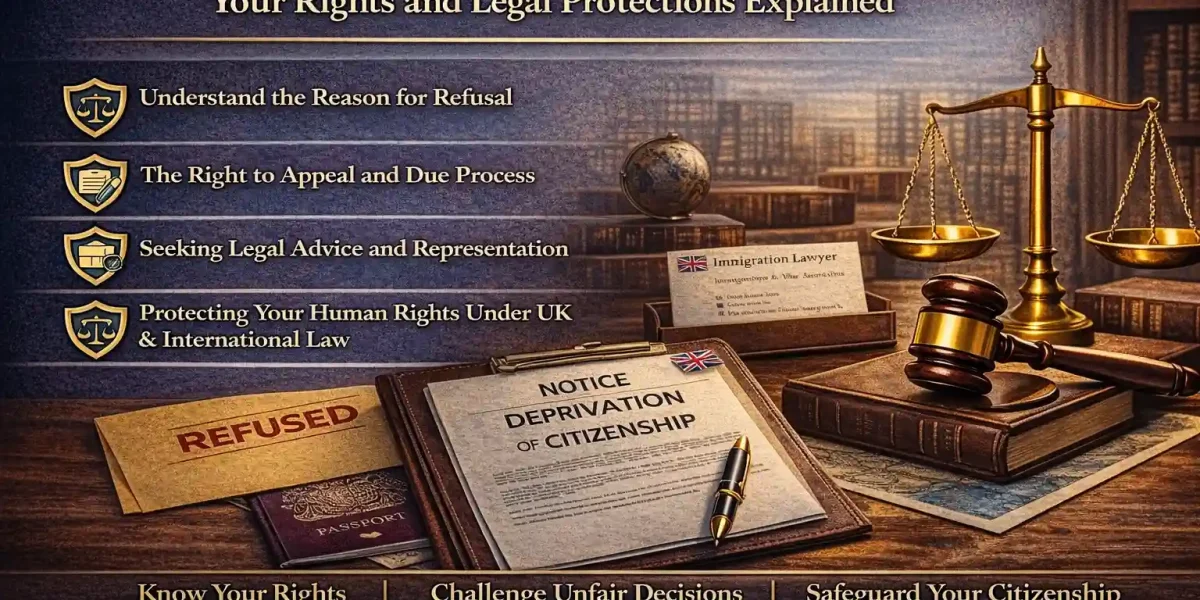
Deprivation of British citizenship is one of the most serious steps the Home Office can take against an individual. It removes a legal status that often forms the foundation of a person’s residence, family life, and long-term future in the UK. Because of the gravity of the decision, Parliament has set strict legal limits and procedural safeguards that the government must follow.
This article explains those rules in clear terms, outlines your rights, and shows what protections are available if you are affected by a deprivation notice.
Legal Basis Under the British Nationality Act 1981
The Home Secretary holds the power to deprive a person of British citizenship under Section 40 of the British Nationality Act 1981. This power is carefully restricted and can only be used in two situations. The first involves cases where a person’s citizenship was obtained through false information or the hiding of important facts. The second concerns individuals whose conduct gives rise to serious concerns about national security or strong public interest considerations.
Section 40 requires the Home Office to act fairly and proportionately. It also requires the decision-maker to justify the measure through evidence, not suspicion or speculation. The tribunal system closely examines these decisions, and the Home Office must be prepared to defend each step taken.
Deprivation on Grounds of Fraud
Fraud is one of the most common reasons cited in deprivation cases. This can occur when a person obtains citizenship with false information or by failing to disclose essential details that would have affected the outcome of their earlier immigration applications. Examples include using fabricated documents, failing to reveal criminal convictions, or entering a marriage that did not legally exist at the time of application.
In fraud cases, the Home Office must show that the person would not have been granted citizenship had the truth been known. The legal test is the “balance of probabilities”, meaning the Home Office must show the event or omission was more likely than not. This is a civil standard, not a criminal one, which allows the tribunal to assess the evidence as a whole.
Fraud cases often involve large volumes of documentary material. The Home Office may rely on historical immigration files, previous interviews, and external checks with foreign authorities. Individuals facing this allegation should gather all records that support their original applications and challenge incorrect assumptions promptly. Expert legal representation is essential in these cases since the factual history can span many years.
Deprivation Based on Conduct Considered Harmful to the Public Good
The Home Office may also deprive a person of British citizenship if their actions are considered harmful to the public good. This route is used sparingly and usually involves conduct linked to national security risks or serious organised criminal activity. Cases related to terrorism, espionage, and participation in violent groups often fall within this category.
The Home Secretary must demonstrate that the conduct presents a current risk and that deprivation is justified in the wider public interest. This is not a punishment for past conduct. Instead, it is positioned as a preventative measure based on the scale and seriousness of the risk. The assessment includes a detailed evaluation of intelligence reports, behaviour outside the UK, and any involvement with extremist organisations.
Many cases in this category are handled through closed evidence procedures due to national security concerns. This means the individual does not see all the evidence presented to the tribunal. In these situations, a special advocate is appointed to represent the person’s interests during the closed sessions, ensuring a fair process while protecting sensitive information.
Procedural Safeguards and the Right to Notice
The Home Secretary is usually required to issue written notice of a deprivation decision. The notice must explain the reasons for the decision and set out the appeal rights available. It must also include information on the deadlines for appealing, which are strict and require immediate action.
There are exceptional situations where notice may not be given directly to the individual, usually for national security reasons or when the person cannot be contacted despite attempts by the authorities. Even in these cases, the decision is recorded formally, and oversight is provided by the Special Immigration Appeals Commission. This means that the Home Office cannot avoid scrutiny simply by withholding notice.
The notice stage is crucial because it initiates the appeal period. Individuals should act immediately upon receiving a deprivation letter, as failure to appeal in time may limit the options available later.
The Right to Appeal and Legal Recourse
Every person facing deprivation has the right to appeal, either to the First-tier Tribunal or, in national security cases, to SIAC. The tribunal examines the Home Office decision in full. It can assess the factual background, the legal arguments, and the proportionality of the decision. The tribunal can uphold the decision or overturn it entirely.
Understanding your rights during UK citizenship deprivation cases is essential at this stage because appeals can involve complex legal tests, closed evidence procedures, and issues that require careful handling. Individuals who are fully aware of these rights are better placed to challenge flawed reasoning, highlight procedural problems, and ensure that their position is presented accurately.
In SIAC cases, part of the evidence may be closed and viewed only by the special advocate and the tribunal. The special advocate’s role is important. They ensure the individual’s rights are protected even though they cannot discuss the closed material with the appellant after reviewing it. Although this process is unusual, it is designed to ensure fairness while protecting information that could cause harm if released publicly.
Appeals involve strict time limits. Missing a deadline can have serious consequences. Individuals should seek immediate advice from qualified solicitors who understand deprivation law and tribunal procedure.
Protection Against Statelessness
UK law includes important restrictions on deprivation that would render a person stateless. In cases based on the public good, the Home Secretary normally cannot take away citizenship if doing so would leave the person without any nationality. There is a limited exception for individuals who have acted in a manner seriously harmful to the UK’s vital interests and who are able to obtain citizenship of another country.
This rule does not apply in fraud cases. If citizenship was obtained incorrectly, British nationality can be removed even if the individual becomes stateless as a result. This is because the law treats the original grant as invalid from the outset.
The statelessness assessment can be complex, especially where the person has disputed nationality, unclear documents, or connections to more than one country. Expert legal work is often required to assess risk and present evidence about nationality status.
Human Rights Considerations
Human rights protections play an important role in deprivation decisions. The Home Office must assess the impact on the person’s family life, private life, and the wellbeing of any children. Article 8 of the European Convention on Human Rights requires a careful, fact-based assessment to determine how deprivation would affect the individual’s daily life and long-term future.
This includes examining ties to the UK, cultural integration, health conditions, and the effect on children who may rely heavily on the parent facing deprivation. The weight of these factors varies by case, and the tribunal will consider them in detail. In some cases, strong family life considerations have been enough to overturn the Home Office decision.
Importance of Legal Representation
Given the seriousness of deprivation, representation is vital. Individuals should seek assistance from trusted UK solicitors for complex legal matters who understand nationality law, tribunal procedure, intelligence-based evidence, and human rights protections. Effective representation can expose errors in the Home Office’s reasoning, challenge unreliable allegations, and present evidence in a structured and persuasive manner.
Solicitors also play a key role in managing deadlines, preparing appeals, and obtaining expert evidence such as country reports, nationality assessments, psychological evaluations, and witness statements.
Judicial Oversight and Accountability
Every deprivation decision is subject to scrutiny. The tribunal examines the Home Office’s reasoning, the evidence presented, and the fairness of the process. Judicial oversight prevents arbitrary action and provides an essential safeguard for individuals who may face severe consequences if citizenship is removed.
The tribunal can question the reliability of intelligence, the proportionality of the decision, and the relevance of past conduct. This independent review ensures that no deprivation decision rests solely on the Home Office’s view.
What To Do If You Receive a Deprivation Notice
Immediate action is essential. Check the deadline for appealing and seek legal support at once. Collect all documents relating to your immigration history, identity, and family life. Provide full instructions to your legal representative so they can build a complete picture of your case.
You may also be able to request the Home Office’s evidence under disclosure procedures. Respond quickly to requests for information, and remain in regular contact with your solicitor throughout the process.
FAQs
Can deprivation of citizenship affect my family members?
No. Deprivation applies only to the individual whose citizenship is revoked. However, family members could face indirect consequences, such as changes to immigration status or loss of derivative rights, especially if their permission to stay was based on the person whose citizenship has been removed.
How long does the deprivation appeal process take?
Appeal times vary depending on complexity and whether the case goes to the First-tier Tribunal or SIAC. Simple cases may conclude within months, while national security cases involving closed evidence can take a year or longer due to the volume of classified information.
Can I travel outside the UK during an ongoing appeal?
Travelling abroad during an appeal is not recommended. Departure could lead to difficulties re-entering the UK or continuing the appeal process, particularly if the deprivation decision removes your citizenship while you are outside the country.
What happens to my passport after a deprivation notice?
Once deprivation proceedings begin, the Home Office can cancel or seize your British passport. The document immediately becomes invalid, even before the appeal concludes. This is part of the government’s control to prevent misuse of travel documents while the case is under review.
Can deprivation of citizenship be reversed?
Yes. If the appeal tribunal or SIAC finds that the deprivation decision was unlawful or disproportionate, the individual’s British citizenship can be reinstated. In some cases, the Home Office may also be ordered to return documents and correct records across all relevant government departments.
Navigating the intricacies of sponsor licence applications can be daunting for many organizations. To ensure a smooth process, it’s essential to understand how Immigration Lawyers approach these complex cases and the strategies they employ to overcome potential challenges.
